×
- Hello
- Login or Register
- Quick Links
- Live Chat
- Track Order
- Parts Availability
- RMA
- Help Center
- Contact Us
- Shop for
- Acura Parts
- Acura Accessories

My Garage
My Account
Cart
Genuine Acura Legend Engine Block
Cylinder Block- Select Vehicle by Model
- Select Vehicle by VIN
Select Vehicle by Model
orMake
Model
Year
Select Vehicle by VIN
For the most accurate results, select vehicle by your VIN (Vehicle Identification Number).
19 Engine Blocks found
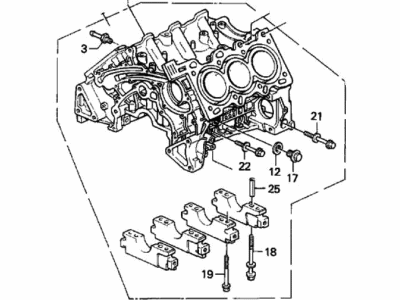
Acura Legend Cylinder Block Assembly
Part Number: 11000-PY3-000$2553.40 MSRP: $3366.16You Save: $812.76 (25%)Ships in 1-3 Business Days
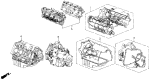
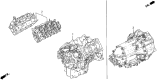
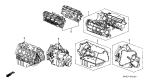
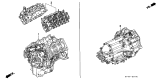
Acura Legend Engine Block
The Engine Block for the Acura Legend is the part of the car that holds moving parts in position, routes oil and coolant, and similar V6 components. Primarily aluminum with cast iron liners, this Engine Block has the low weight and structural robustness required to cradle the crankshaft and pistons. It achieves a balance that remains true to Acura performance goals. The Engine Block is machined precisely after casting, giving precise deck surfaces, main bearing saddles, and bored cylinders that promote good sealing and combustion efficiency. The oil and water passages are of oval cross-section. Pressurized oil is pumped through internal galleries of the Engine Block to the lower and upper bearings. A water jacket flows water around the cylinders and back to the radiator to remove heat. Throughout the production run, every Legend model relied on a 60-degree V-type layout instead of an inline layout, allowing six cylinders to be fitted compactly without compromising smoothness. Although the early units had a few slight differences in machining that were later refined to provide quieter operation with a longer life, each Engine Block maintained an integrated crankcase to enhance rigidity. Strengthening the Legend, whose reputation was firmly established for refinement, helped Acura owners enjoy long service.
We provide a broad range of OEM Acura Legend Engine Block at unbeatable prices on our website. For your OEM parts, You can count on the guaranteed quality, manufacturer's warranty, outstanding customer service, and prompt delivery. We look forward to your visit.
Acura Legend Engine Block Parts Questions & Experts Answers
- Q:How to Properly Clean and Prepare an Engine Block for Reassembly on an Acura Legend?Posted by Kevin U.A:Using a gasket scraper, remove all traces of gasket material from the engine block, taking care not to nick or gouge the gasket sealing surfaces. Remove the main bearing caps and bridge, separating the bearing inserts from the caps and the engine block, tagging the bearings to indicate their original cylinders, with the oil groove identifying the upper bearings. Remove all threaded oil gallery plugs from the block, which may be very tight and could require drilling out and retapping the holes, using new plugs upon reassembly. If the block is extremely dirty, it should be taken to an automotive machine shop for steam cleaning or tanking. After cleaning, ensure all oil holes and galleries are cleaned again using brushes designed for this purpose, flushing with warm water until clear, drying thoroughly, and wiping machined surfaces with light rust preventive oil, utilizing compressed air if available to expedite drying and clear oil holes and galleries. If the block is not excessively dirty, a thorough cleaning with hot soapy water and a stiff brush is sufficient, ensuring all oil holes and galleries are cleaned, dried completely, and coated with light oil. Clean the threaded holes in the block to ensure accurate torque readings during reassembly by running the proper size tap into each hole to remove rust, corrosion, thread sealant, or sludge, restoring damaged threads, and clearing debris with compressed air if possible. Clean the threads on the head bolts and main bearing cap bolts as well. Reinstall the main bearing caps and tighten the bolts finger tight. Apply non-hardening sealant to the new oil gallery plugs and thread them securely into the holes in the block. If the engine will not be reassembled immediately, cover it with a large plastic trash bag to keep it clean.Answered by Acura Parts Specialist Mitch / Aug 17, 2023


